

~ From rate-equation implementation to wax isomerization / hydrocracking and product quality assessment ~
Fischer-Tropsch (FT) synthesis is a core technology for producing liquid fuels and chemicals from syngas (CO + H2). Its greatest strength is that it can be applied regardless of the feedstock: natural gas (Gas to Liquid, GTL), biomass (Biomass to Liquid, BTL), or CO2 + green hydrogen (Power-to-Liquid, PtL).
At the same time, the viability of an FT synthesis process depends heavily on how conversion in the reactor is designed and on the technology used to turn the heavy wax by-product into salable products. With a rigorous reactor model based on rate equations at its core, Simuarts supports process studies that span FT synthesis, wax hydrocracking and isomerization, and product fractionation.
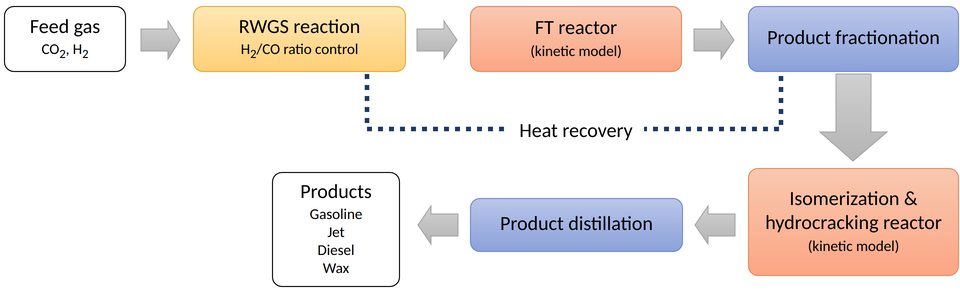
Schematic flow diagram from FT synthesis to the isomerization / hydrocracking model
Challenges in FT Synthesis Process Studies
Limitations of fixed-yield models
Fixed-yield models based on the Anderson-Schulz-Flory (ASF) distribution, which are widely used in conceptual studies, cannot predict behavior when the feed composition or the operating conditions change. Any study that covers reactor volume, catalyst loading, heat removal conditions and recycle configuration requires a reactor model built on rate equations.
Reactor selection and the importance of the upgrading section
FT synthesis is a strongly exothermic reaction, and slurry-bed and multitubular fixed-bed reactors differ substantially in conversion, selectivity, scale-up characteristics and ease of catalyst replacement. Furthermore, product yield and product quality are only determined once the step that converts the heavy wax by-product into middle distillates by hydrocracking and isomerization is included. A quantitative comparison covering the entire process is therefore an essential basis for selecting a configuration.
Simuarts FT Synthesis Modeling Technology
Drawing on kinetics reported in peer-reviewed literature and on the ASF distribution, we have built a flowsheet model in Aspen Plus(R) that implements the complete chain from CO2/H2 gas through FT synthesis, wax hydrocracking and isomerization, to product fractionation.
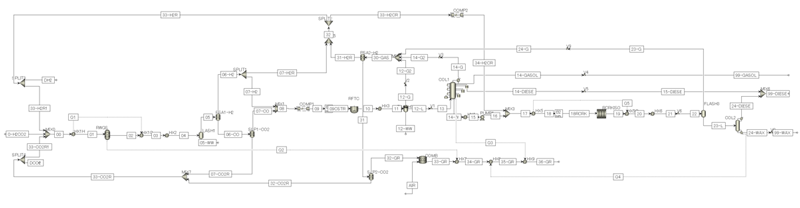
Aspen Plus(R) simulation screen (FT synthesis, hydrocracking and isomerization model)
(1) Implementation of FT synthesis rate equations
The FT synthesis reactions are described with LHHW (Langmuir-Hinshelwood-Hougen-Watson) type rate equations, and the formation of linear paraffins with carbon numbers 1 to 30 and olefins with carbon numbers 2 to 30 is modeled for each carbon number. The model also accommodates changes in the chain growth probability alpha caused by different catalysts and reaction conditions, and we can estimate rate-equation parameters from your own catalyst test data.
FT synthesis is represented by a CSTR model simulating a slurry-bed reactor, from which conversion and catalyst loading are calculated. Please contact us if you require conversion to a plug-flow model for a multitubular fixed bed. A fixed-bed model allows the temperature profile inside the tubes to be analyzed and can be used to study the number of heat-transfer tubes and the tube diameter.
(2) Modeling of wax isomerization and hydrocracking
Converting the heavy wax by-product of FT synthesis (mainly n-paraffins) into middle distillates makes the design of the isomerization and hydrocracking step critical. We have a reactor model that implements the reaction set for carbon numbers 10 to 30 as LHHW-type rate equations.
The reactor is modeled as a catalyst-weight-based plug-flow reactor, with the catalyst loading set according to the wax throughput. This makes it possible to predict the effect of reaction temperature, pressure and LHSV on cut yields, as well as the iso/normal paraffin ratio in the product. The iso-paraffin ratio governs low-temperature flow properties such as the freezing point of jet fuel, and the ability to optimize operating conditions for both yield and quality is a key feature of this model.
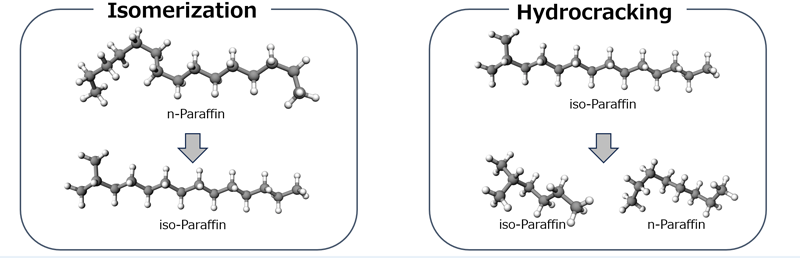
Illustration of isomerization and hydrocracking
* The 3D structure of each component is taken from the NIST Chemistry WebBook.
NIST Chemistry Webbook
(3) Process optimization including separation, recycle and heat integration
The product oil is separated into product cuts in a fractionation column. H2 recovery from the off-gas (PSA) and its recycle, CO2 separation and recycle, and residual gas combustion with heat integration are all built into the flowsheet, so that carbon efficiency and energy efficiency are evaluated across the process as a whole.
Applicability to a Wide Range of Feedstock Routes
Because a common model is used for the steps downstream of FT synthesis (reactor, hydrocracking, isomerization and fractionation), comparisons between feedstock routes and case studies that assume feedstock switching or blending can be carried out efficiently.
Prediction of Product Properties and Assessment Against Fuel Specifications
Product properties such as the distillation curve, density and viscosity are obtained from the physical property calculations in Aspen Plus(R) and can be checked against the specification items for jet fuel (ASTM D7566) and diesel fuel. Flash point and freezing point are evaluated using correlations taken from the literature, allowing product quality to be linked directly to process conditions.
Cost Estimation and Techno-Economic Assessment (TEA)
Based on the material and energy balances obtained from the simulation, we calculate the product manufacturing cost from capital cost (CAPEX), feedstock cost, maintenance cost and utility cost. Differences in reactor type, recycle configuration and feedstock route are compared from an economic standpoint and combined with TEA, so that both technical viability and business feasibility are evaluated quantitatively.
Consult Us About Your FT Synthesis Process Study
From literature surveys through process simulation with implemented rate equations, optimization and techno-economic assessment (TEA), Simuarts provides end-to-end support. If model development, scale-up or cost evaluation is giving you trouble, please get in touch. Our experienced engineers will propose the solution best suited to your specific challenge.
