

— From a rate-based RPB model in Aspen Custom Modeler to process simulation and TEA in Aspen Plus —
Amine scrubbing is the leading way to capture CO2 from power-plant and industrial flue gas, but the large gas flows call for very large absorber columns. A rotating packed bed (RPB) spins the packing so that centrifugal force intensifies gas–liquid contact. It can do the same job in a far smaller unit, which has made it a technology to watch.
However, general-purpose process simulators have no standard RPB model, so designing an RPB and judging its economics is difficult. SimuArts has built a rate-based RPB absorber model in Aspen Custom Modeler (ACM). Around this model, we support RPB-based CO2 capture studies end to end: solvent property setup, process simulation, cost estimation and techno-economic assessment (TEA).
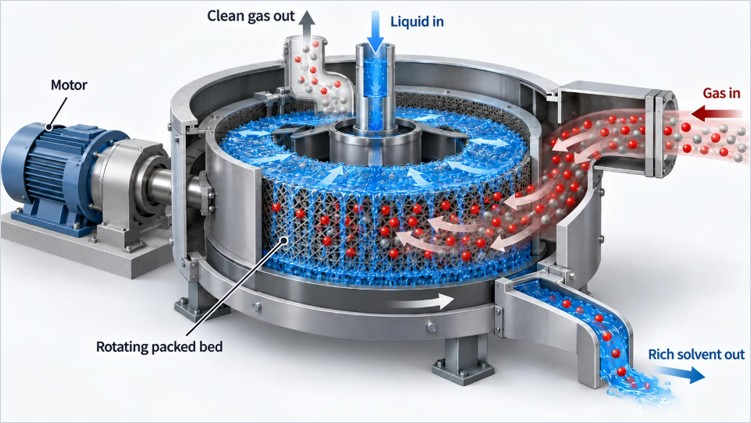
Structure of a rotating packed bed and its flows (liquid moves outward from the center; gas moves inward from the rim, in counter-current contact)
Challenges in Designing CO2 Capture Processes
Very large absorbers
A 250 MW natural gas combined cycle (NGCC) plant emits about 1 million Nm³/h of flue gas at about 5 % CO2. Capturing 90 % of it in a conventional packed column (PB) takes an absorber 17–19 m in diameter. Plot area, construction cost, and transport and installation all become major constraints.
No quantitative way to evaluate a new device
An RPB shrinks the equipment, but it adds rotor power and gas-side pressure drop. Whether the smaller size pays for itself depends on the case. Answering that question needs an equipment model that captures mass transfer, reaction and hydrodynamics, plus a consistent way to evaluate the whole process’s mass and heat balances, capital cost and operating cost.
What Is a Rotating Packed Bed?
The RPB was proposed by ICI in the UK in the late 1970s under the name “HiGee” (high gravity). An annular bed of packing rotates, creating centrifugal acceleration tens to hundreds of times gravity. The liquid breaks into thin films and droplets and meets the gas in counter-current flow. Because the interfacial area and mass-transfer coefficients become much larger, the same separation needs far less packing volume than a column.
For CO2 capture, RPBs offer the following benefits:
– Small and light: packing volume can be cut to about 1/3–1/6 of a packed column (SimuArts estimate).
– Centrifugal force keeps liquid films thin even with viscous, highly concentrated amine solvents.
– Low liquid holdup reduces the solvent inventory in the unit.
– Insensitive to tilt and motion, which makes offshore use promising.
On the other hand, rotor power and gas-side pressure drop (blower power) increase. Deciding whether to adopt an RPB therefore requires a quantitative comparison at the whole-process level.
Our RPB Modeling Technology
Simuarts developed its own RPB absorber model in Aspen Custom Modeler (ACM) and embedded it in Aspen Plus flowsheets, so the entire CO2 capture process can be evaluated.
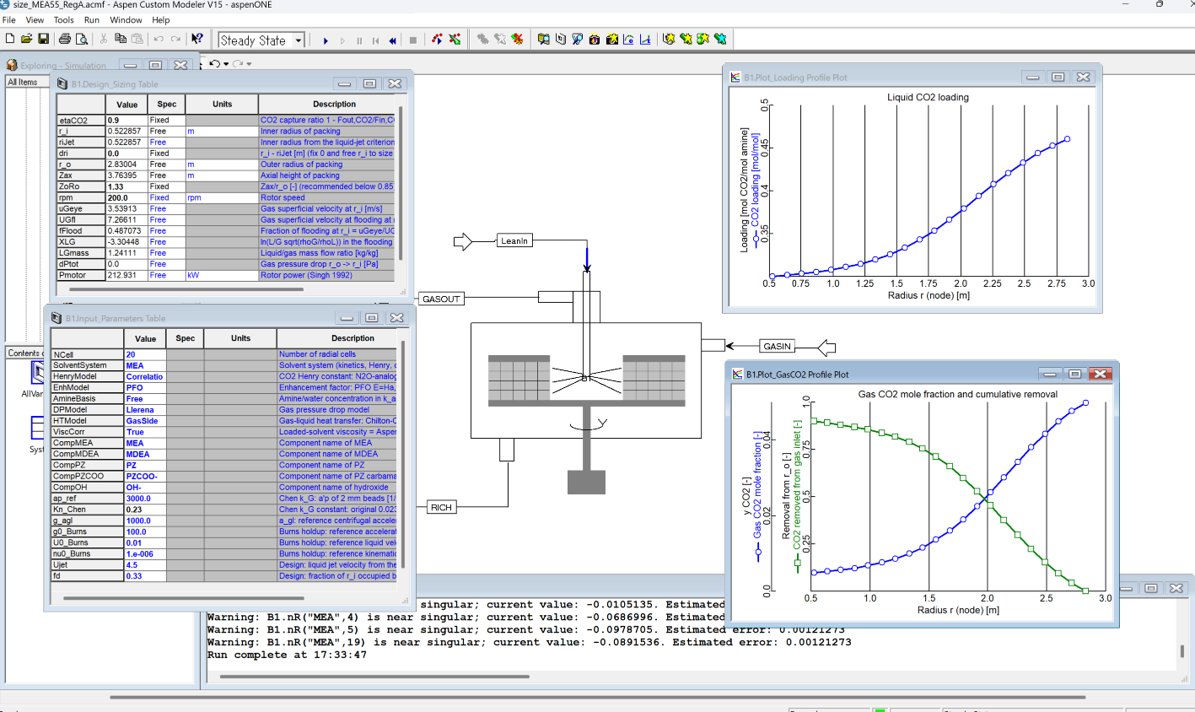
RPB absorber model in Aspen Custom Modeler® (input and result tables, radial profiles)
1. Rate-based RPB absorber model
The rotor is divided into 20 radial cells. In each cell the model solves gas and liquid mass and heat balances, mass-transfer rates, and the enhancement of absorption by chemical reaction. Published RPB correlations give the mass-transfer coefficients, interfacial area, liquid holdup, pressure drop and rotor power. Physical properties come directly from Aspen Properties using the electrolyte NRTL model (eNRTL-RK).
The model supports both rating (performance from given dimensions and speed) and design (dimensions needed to reach a target capture rate).
2. Switchable solvents and property development
A single parameter switches the solvent system between MEA (30–75 wt%), MDEA + PZ and AMP + PZ (CESAR1). Properties for each solvent come from Aspen Properties files built from the Aspen Plus property definitions.
For newly developed solvents, we can also tune the property models to your experimental data.
③3. Process evaluation in Aspen Plus
The ACM model is exported to Aspen Plus as a user model and placed in a CO2 capture flowsheet with the stripper, heat exchangers and compressors. Results in Aspen Plus match the standalone ACM model to 5–6 significant digits. With rich and lean solvent recycles in place, solvents and operating conditions can be compared directly.
Model Validation
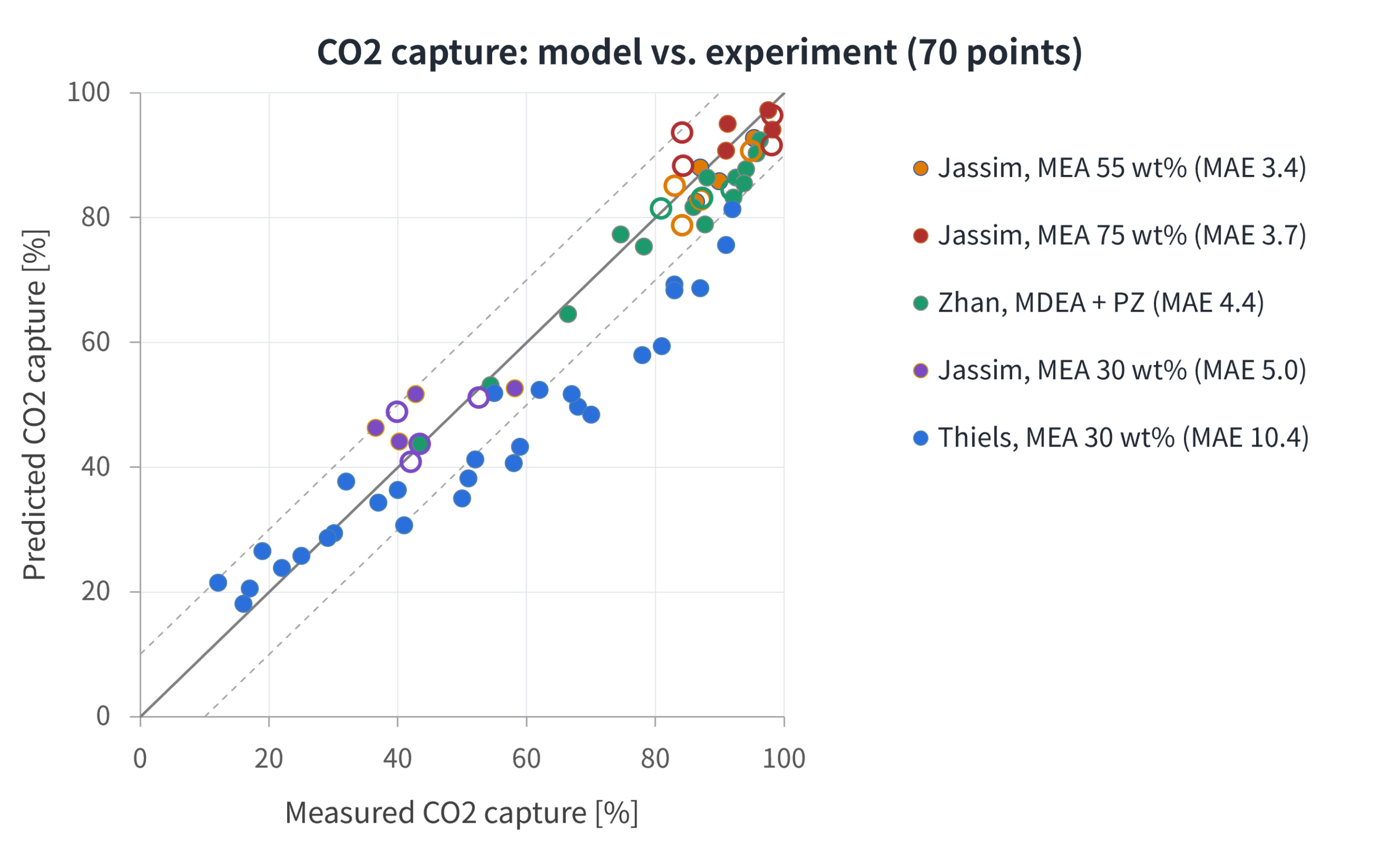
We compared the model with 70 published data points from RPB CO2 absorption experiments. The mean absolute error in CO2 capture rate was 6.8 percentage points. Only two parameters were fitted to the data: one in the mass-transfer correlation and one in the interfacial-area correlation.
By data set, the error is 3–5 points for the Jassim et al. and Zhan et al. experiments and 10.4 points for Thiels et al. The validated range runs from lab scale up to a 0.4 m outer diameter, so commercial-scale units (several meters in diameter) are an extrapolation. We report results together with sensitivity studies that show this uncertainty.
Consult Us on RPB and CO2 Capture Processes
From literature review onward, SimuArts supports the whole study: assessing whether an RPB fits your case, comparing solvents, developing properties for new solvents, building models in ACM and Aspen Plus, and cost estimation and TEA. Our experienced engineers will propose the solution that best fits your challenge.
